

Showing posts with label southampton. Show all posts
Showing posts with label southampton. Show all posts
Saturday, 17 October 2026
Wednesday, 22 July 2026

Friday, 1 May 2026
Baroque Majesty: Bournemouth Symphony Orchestra and BSO Voices at The Guildhall Southampton


I went to the Baroque Majesty event last Saturday night at the O2 Guildhall in Southampton. It was billed as a joint performance by the full Bournemouth Symphony Orchestra and their community choir, BSO Voices. The programme mixed familiar baroque pieces with some less common ones. It was the best audio experience of my life.
The first thing that struck me was the choir. There were at least 120 singers on stage. BSO Voices is open to anyone—no auditions, no music-reading requirement—and the sheer number gave the choral sound a weight that smaller groups rarely achieve. It filled the hall without needing heavy amplification.
Pete Harrison conducted. He is the regular director of BSO Voices and came across as a warm, engaging character: authentic, funny, and clearly at home with the repertoire. He kept things moving without unnecessary drama.
The orchestra used roughly the numbers listed on the BSO roster, scaled back for baroque work. Strings came in at around 33 players (10 first violins, 8 second violins, 6 violas, 5 cellos, 4 basses). Woodwinds totalled about 6 (2 flutes/piccolo, 2 clarinets, 2 bassoons; oboes vacant). Brass numbered around 10 (4 horns, 2 trumpets, 4 trombones/tuba). There were 2 on percussion/timpani and 1 harpist, who also had a Roland keyboard set up. The balance stayed clear throughout.
What stood out most was the interplay between the sections. The choir and orchestra locked together cleanly on several numbers. My three strongest pieces were the opening Vivaldi *Gloria in excelsis Deo*, the Handel Sarabande, and the closing Messiah excerpts. The full Messiah runs about three and a half hours; they took selected movements including “For Unto Us a Child Is Born,” “All We Like Sheep,” and the Hallelujah Chorus. Those sections delivered the cleanest, most direct impact of the evening.
Well actually Zadok the Priest was a slow burn banger. Handel's *Zadok the Priest* (Coronation Anthem No. 1, HWV 258) opens with a famously long, quiet, and stately orchestral introduction—roughly 1–1.5 minutes of soft, repeating string patterns that build tension very gradually. This section is often marked *Andante maestoso* in editions (or left unmarked by Handel himself) and sits around 80–96 BPM in typical recordings. It can feel drawn-out or processional, which is probably why it landed in the “slower baroque items” category, but it certainly gains ground.
After that, the choir and trumpets enter with a sudden forte, followed by a dance-like middle section in 3/4 time and a final “God save the King” part full of chordal declarations plus fast semiquaver runs in the Amens. The whole piece usually runs 5–6 minutes and is described as majestic and ceremonial overall, not uniformly slow.
Actually, the God save the King, and Lord of Lords religious exhortations curled my lip a bit but there is something about religious singing from the 18th century fur Ein gutes Gefühl.
The extended suspenseful opening is the part that often strikes listeners as slower or less engaging compared to the punchier Vivaldi Gloria or Messiah excerpts.
Not every piece landed for me. Some of the slower baroque items (Bach Air on a G String, Pachelbel Canon, Handel Largo from Xerxes, Purcell Chaconne) sometimes felt drawn out and less engaging. Still, the night as a whole was exceptional. The hall acoustics were fine, the playing was tight, and the combined forces produced a big, professional and unforgettably coherent sound.
I got home well after the concert absolutely buzzing on good energy for hours afterwards. Inject more of that into my veins.


Thursday, 11 July 2024


Saturday, 2 December 2023
The Nutcracker - English National Ballet

The ticket fairy flew by and dropped an invitation in my lap, so I got to see the English National Ballet's 'The Nutcracker' last night and it was worth it for the last six minutes alone. Helicopter view first. When the opening curtains parted the set was dripping in richness, luxury and elegance, and this continued with every set change throughout the performance. The art of set designing has improved beyond description since my theatre days in London. If like me for quite some, you haven't been to the theatre, I urge you to try again. It's so much more immersive.
The first act caught me by surprise, there were about 25 ballet dancing children as the mice or skating soldiers, and they were really good, I didn't see a single mistake. How do they get all those children off school and performing around the country? All of them transformed into real mice at one point with collective fingers waggling like the whiskers and paws twitching as mice eat. However I was anticipating the grown ups to take over and to be candid, I didn't see the kind of performance I was expecting. Now, it might have been the view I had or the excessively hot theatre, or even the version being watched, but the only performance worth noting was the lead female dancer. I believe her name is Fernanda Oliveira from Brazil. Where Yijing Zhang of Birmingham Royal Ballet was magnetically tall, Fernanda's Sugar Plum fairy was diminutively hypnotic. Precision, levitation and elegant symmetry all rolled into one. Superb stuff.
The second act was closer to my expectations. More Corp de Ballet, more Batterie and an astonishing Coda. I think it says more about me than anything but I don't understand why Swan Lake, not The Nutcracker is most popular in the United States. I've also come to the conclusion that if there's no orchestra I'm not going to attend. The richness of sound, in this case the ENB Philharmonic, is something no sound system can come close to. When I went to see Matthew Bourne's Sleeping Beauty earlier this year I didn't write it up as I thought it was crap for various reasons but more expensive tickets and no Philharmonic Orchestra will suffice. Anyway, the wrap up Coda of ENB's The Nutcracker was a dazzlingly baroque, twisting Rubik's Cube of light, shadow and writhing bodies, internally-externalising with the mechanism and precision of a watch. I'll add close examples to the post below. It was worth every penny just for that and I left delighted.


Saturday, 30 September 2023
1. the prefix meta- comes from a Greek word meaning “beyond” or “change.” 2. the root morph comes from a Greek word meaning “shape.”1. the prefix meta- comes from a Greek word meaning “beyond” or “change.” 2. the root morph comes from a Greek word meaning “shape.”

Heaps of talent
— CFX (@C__F__X) September 30, 2023
Ms Greta is the #StarWars
by far
cfx pic.twitter.com/GTSH9geyVL

mast studios/South Hamptons
Friday, 28 April 2023
Kyiv City Ballet


I went to see Kyiv City Ballet last week for their gala performance in Southampton.
They're exiled and inevitably (somewhat) stranded in the former Warsaw Pact country Croatia after a stint in Paris.
There's a lot I noticed and ordinarily would wish to write about, but now isn't the time.
Kyiv City Ballet were sparse but dignified.
They were professional with a wide ranging and versatile repertoire.
There was nothing but effort, and from time-to-time unforgettable performances from a skeletal ballet company under pressure, surviving at first week to week, followed if lucky by month to month, and then inevitably we tell ourselves the years trundle or roll by-on-by.
Not once did they solicit maudlin sympathy or allow anger, jingoism or bitterness spoil their performance.
If anything was obvious, it was the absence of propaganda in either direction, and not its presence as it were.
The dancer in three images above, was not only extraordinary in a fluid and uncoiling manner, but the music for his sleeveless black-tunic performance has tested my sanity (help me out here please) trying to find it. I pulled my phone out to sound-search using Google Assistant but unsuccessfully.
I was hopeful it might be Le Spectre de la Rose (Carl Maria von Weber's Aufforderung zum Tanz - Invitation to Dance) or Elgar's Nimrod (Tribute to Peace) from the single-sheet concert program I subsequently located, but my hopes were skripaled early on and I've yet to find what I'm looking for.
Show must go on.
Update. I received a lovely email from Croatia and I have the music so I'll be sharing that and more.
Wednesday, 8 February 2023
Birmingham Royal Ballet - Swan Lake


I haven't been to the ballet since Paquita, by the Ballet de l'Opera national de Paris in Beijing, 2008. You can read that linked review if you wish but at the time I couldn't tell the full story as I was a career-focused guy and this blog was mainly for advertising professionals. Well, I got stoned before heading out to the ballet at the Egg cultural centre. I lived just off Tiananmen square, and hopped onto my electric bike to see the show. I was just a smidge too stoned and miscalculated the time I'd need to take a different route around the square than usual, so I was the last person to arrive at the theatre. The ushers at the end of a long corridor were beckoning me wildly to move my ass as the show was just about to begin, so I legged it down the corridor and they let me in, closing the doors behind me.
I was high, out of breath, heart beating wildly, and as I looked around the theatre, the entire Beijing audience turned to gaze at me disapprovingly, knowing full well it was me that had held things up. I had a really good centre seat ticket, so half an entire row had to stand up to let me get there, while I apologised profusely. I sat down and the ballet began immediately.
I'd heard that sometimes performers will choose a person in the crowd to play to on a personal level, to bring out the best and most sincere dramatization, and that night, I was that guy. The lead dancer, a beautiful Parisienne based swan looked at me straight in the eye all night, even to the last pirouette where she gracefully collapsed to the stage floor, arms open looking at me.
Wow, what a night.
Southampton has one of the largest theatres outside of London and is the largest on the South coast. It only takes ten minutes to walk there from my home and I'm grateful to have exceptional cultural content so close to me.
As soon as the curtain raised for Swan Lake I was mesmerised. Stagecraft has progressed noticeably since my last ballet and it looked more real than reality, but in a holographic sense, more three dimensional and I was excited. Act I introduced our hero Prince Siegfried, his wingman Benno and his mother the Queen dowager who is recently widowed. Permit yourself to an appetiser if the text is worth returning to, or not. Let it speak for itself
The first intermission was described as a three-minute scene change but took so long many of the audience seated near me pointed out that a toilet break or a quick drink at the bar may have been possible but eventually the curtain raised and Act II commenced.
Siegfried and Benno have followed a flight of swans to a lake in order to hunt them. This felt transgressive as I am aware that killing swans in the United Kingdom is illegal to kill or eat as they are considered the property of the King. However, the swans they are chasing are in fact human between the hours of midnight and dawn. It is here Siegfried is amazed to see a swan change into the beautiful Odette played by the magnetically tall and exquisitely gifted Yijing Zhang. Some of her moves I'd never seen either a human or a fictional media character ever make.
There was a time when I was training as a gymnast that I did ballet to improve balance, elegance and control. I regret not taking it up professionally. I would have been good. How good? That's another question but the principal male lead, Siegfried played by Tyrone Singleton did an amazing job. This will sound mean but it's just the truth. In these days of the obesity pandemic it's heart lifting to see beautifully formed men and women during ballet. Tyrone's strength raising up Yijing is a sight to behold. This is what the human form was designed for and I'll write about the purposeful destruction of our bodies one day. I now have the date it started and by whom and how.
Many of you will know that I make bold claims fortified with photographic evidence and documentation trails about the use of doubles, masks and clones in the high-profile business of politicians and billionaires and so forth. Swan Lake's central story mechanism is about a double for Odette. Our hero Siegfried falls in love with her but in Act III she is replaced by a black magician double, whose real name is Odile but is for simplicities sake also played by our heroine Yijing. Swan Lake is as contemporary as is possible and for those who recognise the name Odette she was a British agent and French operative Odette Sanson also known as Odette Churchill and Odette Hallowes or Lise as an agent for the clandestine Special Operations Executive.
It's close, isn't it?
Doubles, clones, deception, espionage and subterfuge but in Act III we're back to the Royal court which is now dripping in illuminated red and black shadows for contrast, which is a colour coded and symbolic leitmotif I've been researching for quite some time now since the dance edit of ELO's don't bring me down.
Our handsome hero has fallen for Odette but at court sees double vision Odile and makes the mistake of erroneously pledging his love for her, which is the only magic spell rule that Odette had specified in order for their love to be conjugated.

In a last attempt to gain his attention our Odette locks eyes with Siegfried who finally recognises his mistake and pursues Odette to the lake. After a stunning display of the swans emerging invisibly from ground floor mist before unforgettable choreographed dance scenes, both Odette and Siegfried throw themselves into the lake, thus ensuring that by the morning, their lives will be united in a world of eternal love.
Wednesday, 7 December 2022
The Swiss & NHS Operating Theatres


ACT ONE
I was in a lot of pain and started taking Ibuprofen which always works a treat with me but as the days rolled by, then weeks I was taking them every four hours and towards the end they lost all efficacies. I started taking 2 Paracetemol, then 2 hours later 2 Ibuprofen - It is 2022 after all.
Four weeks into that regime and nothing was working and so I found a stashed antibiotic and necked that. It really helped for a couple of hours. A month of putting things off and I finally conceded I'd have to go to the Emergency Treatment Centre at the local hospital. They used to call it the walk-in clinic but if you ever been to one, 8 out of 10 cats have foot injuries, so it needed a rebrand from a somewhat limp name as it were.
So, I tipped-up at the ETC and as usual the waiting room was full of the rejects from Lourdes. I wasn't looking forward to a few hours with more miserable people, one of whom, naturally I considered to be myself. I approached the counter, and as I was wincing a bit I kind of had my spiel ready for the receptionist so there wouldn't be too many questions. I said my piece and she directed me to sit down in the waiting area with the rest of the crippled and maimed.
I'd barely sat down, when a voice came over the Tanoy (is that the right word? maybe 'speaker' so the youngsters can understand) "requesting Mr. Frith to report to Triage".
As I got up, I felt the entire waiting room's eyes outraged at my priority treatment, but they'd all heard my pitch and I asked for no preference, so I lurched forwards looking straight-ahead to keep the guilt concealed, but everybody knew.
Inside I was dealt with by a competent professional who was more worried I'd poisoned myself and ordered me a taxi for tests at Emergency in the General Hospital.
Living as a beach-bum in Asia I'd learned to sort out meds for myself on a shoestring budget as often, the important ones are available over the counter. This entire fuss could have been handled with antibiotics and a codeine prescription. Instead, it ended nearly three days later, and I'm ashamed to say, at considerable unnecessary cost to taxpayers.
ACT TWO
After getting trolleyed in A&E I was warned it would be a long wait.
It was 6-9 hours punctuated by a 30ish but slight of frame, Indian nurse who came and held my arm.
It was both intimate, in a mammalian sense, perfectly soothing. How much cheaper health care will be when the value of a healing touch returns?
4 or 5 hours into the big wait, I knew I was being toyed with, so I sat up and pulled out the plastic Cannula in my arm. Bad move, blood started spurting everywhere, and so my escape was stymied by mopping the floor first with tissue.
I made it out. Ordered an UBER and sat down for a puff on the pipe.
A couple of security guys came out looking for me.
Are you Charles Frith?
The taxi pulled up, "no that's not my name I replied".
Another guard turned up so that made it three security guards for an escapee patient. Heavy handed I thought.
I submitted in the end.
It was out of embarrassment. I was fighting off all three guards in another man's taxi-carriage and means-of-living. So, I got out, and they nearly frogmarched me back to those boosters y'all used to love, but have since gone off... but which they were gagging to squeeze into me (how I handled that is classified).
After A&E I got the royal treatment again. King Charles, while not impressed, mentioned it was notable.
The guards checked me into a first-class Kubrick COVid Ward in white, then red and black. The receptionist had one of those 2001 head-encasing oxygen suits from Space Odyssey, and yeah, I get a bit triggered by Kubrick, but only in an enthusiastic manner as I've laid out many times before, under the Kubrick tag my friend.
I met a 32-year-old on blood thinners.
His life of drumming for a band [and Football career] all over due to the vaccine. He was great, he made an effort to talk to everyone on the VIP ward the systematic service had just misattributed myself into. I tried to be as candid with him as possible, therefore we talked about much more than myocarditis now scrubbed from the NHS website (and Pericarditis too).
On my life the night-ward Dr spent hours trying to get me more permanent relief than painkillers. I never asked for that, but it was a Promethean attempt at leaping bureaucratic hurdles, I heard every call. She protected me, a Muslim woman protecting an unknown Occidental fella, for hour after hour. Tell me there isn't bravery in the world. Even in the heights of Southampton.
It's not easy to reassemble, as warp-speed space and time, and more, play with the senses. As you well know...
I was awoken by a medical Dr/Teacher and his eager student faces. The smell of warm, freshly baked bread is far superior to smelling salts. I was fully engaged, and then heard him diagnosing me as type 3c.
I'd mentioned it to my GPs but none had any expertise, so my cursory research on the subject was dismissed.
Not through malice, but through ignorance. There's no bitterness. That's a promise. This is now about pragmatism not driving the rear-view mirror
ACT THREE
I was trolleyed through the hospital corridors for what seemed an age in the dead-stillness of the Neon light.
Hushed tones
Sleeping beds
Whispered requests
Procrastination
Security Guards
Redress
My new Homies. I was in the Neurological ward.
None of us awoke at the same time when morning arrived, but the dawn light had risen, and eventually we commenced amiable conversation.
Two beds with faces and the soles of their feet facing me. One bed curtained off to my immediate right.
Windows to the left.
Mr Fawley directly opposite was most hospitable and we chatted about our lives while recuperating... from the very stories that had brought us together. We discussed eclipses and the introduction of light and its withdrawal. Eventually we touched on movies and Masterful Matey to the right chipped in that he liked war movies.
I asked him if he knew that Audy Murphy was the most decorated soldier of WWII?
No, he replied. What film was that?
He asked me if I knew the Latin for Mi Casa es su Casa. I said I thought there was a secret-society similar-story of sharing-meals idiom?
We bonded
Later on, he got his cock out for the bed I haven't mentioned.
He put him down in front of me.
It was a brotherly act
I told you we bonded.
The discharge nurse tried spitefully hard to cut my arm off with the replacement Canula before I bailed out. I swallowed the pain and pretended it was nothing. Why give her the satisfaction. Medical professional my arse. More like resident Satanist.
Nevertheless, that afternoon, I was untouchable. I'm not always untouchable, but when I am I can walk across hot coals like the rest of them.
I caught a taxi home carry a fivers worth of codeine, the antibiotics arrived a little late, but they're stored for a rainy day.
(I'll add the Swiss Intel anecdote later/still ongoing)
Thursday, 27 October 2022
Sir Christopher Robert Chope OBE MP - "Wouldn't Touch A Booster With A Barge Pole"

“Many people now wouldn’t touch a booster with a barge pole and I include myself amongst those
— Janey (@_Janey_J) October 25, 2022
They’re not only counterproductive but also dangerous”
Sir Christopher Chope’s full remarks at Westminster Hall
24.10.22
4 clips ⬇️ pic.twitter.com/dQLOoStS9k
Those are his exact words. The video is embedded below if that helps.
Sunday, 8 May 2022
Craig David & MNEK - Who You Are

I haven't paid much attention to Craig David till recently. He's a Southampton Lad so I do get to hear him on voicefm.co.uk where local talent obviously gets a bit more airplay and that's how I found out this wonderful song was his using Google Assistant to identify the track.
Not only is it a blinder, but it handles homosexuality or gender dysphoria with the kind of restraint that is classy, not obnoxiously shoved down our throats.
Craig comes across to me as a nice guy and when I think about the excessive hammering he got via Bo Selecta it felt overdone and agenda-driven to me. I wonder if he upset someone powerful? That's the usual media agenda when they slag someone off day in and day out like Jeremy Corbyn and Donald Trump.
Craigs voice in this track is as close to angelic I can think of. What a talent.
Not so sure about that MBE though. I'd rather have leprosy than an award of Empire and Royalty.
Another few years or even months and everyone will know.
Wednesday, 6 April 2022
WOW - New Forest ¬ A Year In The Wild Wood


One of my weaknesses [I have them] is I thin-slice people I meet, which is to say that I pigeon-hole them in a few seconds rather than allow their character to shine through.... in its own time.
I don't mind confessing, I thought Peter Owen-Jones was kitted out in the best New Forest squire-attire and was thus fake.
I couldn't have been more wrong. After multiple WOWs I was a fan. I know the New Forest and Lymington fairly well, but I probably quadrupled my knowledge listening to Peter. WOW indeed.
If only the BBC could sell off their propaganda division?
Let the talent flourish I say. It's boastful to pigeonhole this kind of filmmaking as unequalled throughout the world.
It's more accurate in my mind, to say no media institution makes more of this quality.
It's a compliment
Friday, 11 February 2022
Charles Bukowski - The Last Night of the Earth Poems

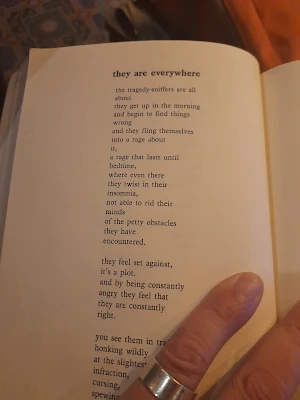

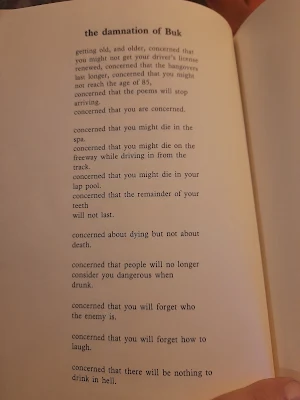

In 2011 I read Charles Bukowski's Post Office and it was brilliant. He's like Orwell, not an extraneous word in the house.... and then I never read him again.
I'm always looking for an excuse to go to Southampton Central Library even though I've got a stack of books outstanding to read on my shelves. I finally remembered Bukowski and dropped by only to find out that the one book they had was overdue for months out on loan, probably never to come back. Would you like this one, the librarian asked.
The Last Night Of The Earth Poems.
I made a face. I've never had much luck with poetry. OK I'll give it a try, and I walked out with one of the best books I've ever read.
There's no point going on about it when you can find out for yourself. It was a peerless companion in the pub with Ruddles and joints. It's impossible not to like Bukowski.
Quarter Jewish, Nazi, Ugly, Funny, Sharp, Filthy, Bum, Gambler, Alcoholic, Loser..... Winner of words and meter.
Philosopher
I laughed out loud on my own many times.
If I get sent to Belmarsh, I'll be alright with just this one book.
Wednesday, 2 February 2022
Reclaim The Streets - 25th September 2021/Southampton


As Outlined in Jerk Jam at Palmerston park, Southampton's Reclaim The Streets day was for all the family.
I noticed that some of those street paving art ideas couldn't resist a little 'it's not woke, it's awaken' efforts above.
Don't forget to check if you had the good, the 50/50 or the bad juice at howbad.info if you or your loved ones, were duped into getting juiced. Most Maxine injury takes a few years to strike if there was no immediate injury in the days and weeks following injection(s)
You might want to consider an HIV test too.


Thursday, 27 January 2022
Jerk Jam Soundclash - Palmerston Park


This is probably the slowest post I've ever finally got round to.
On Friday the 24th of September last year (2021), I was walking home through Palmerston Park and a sound stage was being erected (excuse the pun) for the next day, by the old fashioned bandstand, which leaks quite a bit when it's raining. I know because I've taken shelter there and been joined by all sorts of interesting people ducking for cover in a downpour. That's my electric bike on the right, I want to come back to that subject because as some of you know, I had two electric bikes when I lived in Beijing, during the 2008 Olympics. and there's an obnoxious scam going on with electric bikes in the EU. Let's park that and come back to it another day. Keep the vibes nice because on Saturday 25th, there was music in the park I've previously mentioned right near my gaff, and indeed all over the city centre which was hosting a reclaim the streets day. Art, Music, Culture, Festivities and loads of stuff for children and parents to do. Southampton is close to winning the bid for cultural city of 2025, and as I've mentioned previously, the city has transformed since my years abroad living and working in foreign countries.

When I left Southampton, nobody smoked a joint outside. We had to sneak around and be careful as well as paranoid. But on my return I was blown away when my old mate Chris, who along with his missus, generously put me up (when I returned to be with my terminally ill mother), lit a joint up walking to Common People Bestival festival on Southampton Common, 2017. I thought I was in Amsterdam for a moment, but the reason I mention it, is that by 2021 I was comfortable having a doobie before I joined the crowd dancing at Jerk Jam. The music was reggae and the weather was a bit iffy at one point, but one of the London MCs, literally predicted that the clouds would part and the sun would come beaming through and lo, it happened as he prophesied.
Probably one of the best feelings I've had, or at least up there in the top 20. It was memorable and awesome.
I was so happy for Southampton.
It's come a long way, and there's more to go.
Friday, 10 December 2021
Tyrone - Do What I Wanna Do

I'm not a popular song radio listener by and large, but I've found a local radio station (Voice FM - 103.9) in Southampton that seemingly by design plays an eclectic range from Country & Western to Minimal Tech beats, and everything in between including Classical. Prior to this I'd listen to the South Asian community radio stations to get something with a local feel and unusual music.
I also enjoyed the subject of football for the first time in my life, a couple of weeks back, as they did a seriously long and professional report on a local league with teams from districts I've lived in, or driven through or even been to. So much more satisfying than that multimillionaire celebrity soccer nonsense.
One of the tracks that got my foot tapping even though it's reminiscent of the Aleister Crowley line 'Do What Thou Wiltst', which is not really what I aim for in life, though in practice quite often do, is Tyrone - Do What I Wanna Do [a remix of club classic ‘The Rhythm Of The Night’]. I only discovered a few days ago he's from Southampton and the video is filmed partially in Highcliffe Castle, which is a subject of synchronicity I know I have to return to one day.
Subscribe to:
Posts (Atom)